
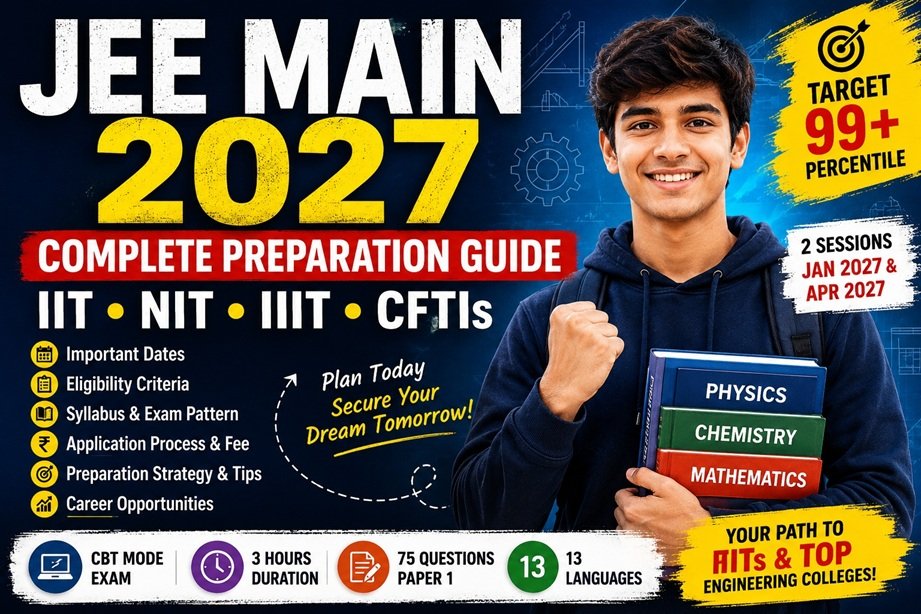
JEE Main 2027: Complete Preparation Guide
Eligibility, Syllabus, Exam Pattern, Important Dates, Application Fee and Career Opportunities
JEE Main 2027 Preparation | Engineering Entrance Examination | NTA JEE Main 2027
Every year, thousands of students across India begin preparing for one of the country’s most competitive entrance examinations with the hope of securing admission to a reputed engineering institution. For many students, getting into an NIT, IIIT or IIT is not just an academic target; it is a dream they have been working towards for several years.
The Joint Entrance Examination (JEE) Main is one of the most important examinations for students who want to pursue engineering, architecture or planning after Class 12. Whether a student is currently studying in Class 11, preparing for board examinations in Class 12, or has already completed school, understanding the examination and starting preparation in the right direction can make a significant difference.
The National Testing Agency (NTA) has officially released the notification for JEE Main 2027 Session 1. According to the public notice dated October 24, 2026, the online application process started on October 24, and the last date for regular registration is November 22, 2026. The January session examination is scheduled for January 20, 21, 22, 23, 24 and 28, 2027.
For students planning to appear in this examination, this is the right time to understand the eligibility requirements, subjects, examination structure and preparation strategy. In this detailed guide, we have covered the important information that every JEE aspirant and parent should know before beginning the application and preparation process.
1. What Is JEE Main?
JEE Main stands for Joint Entrance Examination (Main). It is a national-level entrance examination conducted by the National Testing Agency under the Department of Higher Education, Ministry of Education, Government of India.
The examination is primarily conducted for admission to undergraduate engineering programmes at National Institutes of Technology (NITs), Indian Institutes of Information Technology (IIITs), other Centrally Funded Technical Institutions (CFTIs) and participating institutions.
JEE Main also serves as the qualifying examination for JEE Advanced, which is the entrance examination for admission to the Indian Institutes of Technology (IITs), subject to the prescribed eligibility and ranking requirements.
The examination has three paper options:
- Paper 1: B.E./B.Tech
- Paper 2A: B.Arch
- Paper 2B: B.Planning
Students should select the paper according to the course they wish to pursue after Class 12.
For example, a student interested in Computer Science, Mechanical Engineering, Civil Engineering or Electrical Engineering generally chooses Paper 1. Students interested in architectural design can choose Paper 2A, while those interested in urban and regional planning can consider Paper 2B.
2. Who Can Start Preparing for JEE Main?
One question that parents and students frequently ask is: At what stage should a student start preparing for JEE Main?
The answer is that preparation can begin well before Class 12. However, appearing in the actual examination depends on the eligibility conditions prescribed by NTA.
Class 9 Students
Class 9 is a good stage to develop the basic skills required for future engineering entrance examinations. Students should concentrate on Mathematics and Science, particularly algebra, geometry, basic physics and logical reasoning. There is no need to create unnecessary examination pressure at this age. Building a strong foundation is more important.
Class 10 Students
Students in Class 10 can begin exploring the engineering field and understand what JEE Main involves. They should pay particular attention to Mathematics and Science concepts taught in school. Those who are confident about choosing engineering can gradually become familiar with competitive-level questions.
Class 11 Students
Class 11 is one of the most important stages of JEE preparation. A significant portion of the examination syllabus is connected with the concepts studied in Classes 11 and 12. Students should start following a proper study schedule from the beginning of Class 11 rather than waiting until the final year.
Class 12 Students
Students studying in Class 12 can prepare for JEE Main alongside their board examinations. The key is to maintain a balance between school studies and competitive examination practice. Regular revision and solving previous-year questions should become part of the daily routine.
Class 12 Passed Students
Students who have already completed Class 12 can also appear if their passing year falls within the permitted eligibility period. They should check the official 2027 Information Bulletin before applying.
The most important point is that JEE preparation is not limited to students attending expensive coaching institutes. Students can also prepare through self-study, textbooks, online classes and regular practice.
3. JEE Main 2027 Eligibility Criteria
Before filling out the application form, candidates should carefully check whether they meet the prescribed eligibility requirements.
Educational Qualification: Candidates should have passed Class 12 or an equivalent qualifying examination, or be appearing in the qualifying examination in 2027, subject to the conditions mentioned in the official Information Bulletin.
Permitted Passing Years: The applicable eligibility provisions for JEE Main 2027 cover candidates who passed Class 12 in 2025 or 2026 and those appearing in 2027. Candidates should verify their particular qualifying examination against the official list.
Age Limit: There is no age limit for appearing in JEE Main. However, individual institutions may have their own admission conditions.
Subject Requirements: For B.E./B.Tech admission, candidates should check the prescribed Class 12 subject combination, including Physics and Mathematics and the other permitted subjects. B.Arch and B.Planning candidates should separately verify the subject requirements for their selected course.
Board Examination Marks: Qualifying for JEE Main and meeting the admission requirements of an institution are two different things. For admission to NITs, IIITs and other participating institutions, the commonly applicable Class 12 requirement is 75% aggregate marks or placement in the top 20 percentile of the respective board. For SC/ST candidates, the applicable marks requirement is 65%, subject to the admission rules.
Students must remember that appearing in JEE Main does not automatically guarantee admission. The final selection depends on rank, category, course preferences, seat availability and the applicable counselling and institutional requirements.
4. JEE Main 2027 Important Dates – Session 1
The NTA public notice dated October 24, 2026, has announced the following schedule for the January session.
| Event | Important Date |
|---|---|
| Official notification | October 24, 2026 |
| Online registration begins | October 24, 2026 |
| Last date for application | November 22, 2026 |
| Last date for regular fee payment | November 22, 2026 |
| Late application window | November 23–26, 2026 |
| Late application fee | Additional ₹500 |
| Last date for late fee payment | November 26, 2026 |
| Application correction window | November 27–29, 2026 |
| Examination city announcement | December 30, 2026 |
| Admit card availability | January 13, 2027 |
| JEE Main Session 1 examination | January 20, 21, 22, 23, 24 and 28, 2027 |
Important: The above schedule is for Session 1. Students interested in Session 2 (April 2027) should follow the separate application notification and schedule published by NTA.
Candidates are strongly advised not to wait until the final date. Completing registration early can help avoid payment failures, technical problems and mistakes in the application form.
5. JEE Main 2027 Examination Pattern
Understanding the examination pattern is an important part of preparation. Students should know the number of questions, subjects, examination duration and mode before attempting mock tests.
Paper 1 – B.E./B.Tech
Paper 1 is intended for students seeking admission to undergraduate engineering programmes.
| Subject | Section A (MCQs) | Section B (Numerical) | Total |
|---|---|---|---|
| Mathematics | 20 | 5 | 25 |
| Physics | 20 | 5 | 25 |
| Chemistry | 20 | 5 | 25 |
| Total | 60 | 15 | 75 |
Important details:
- Total questions: 75
- Mathematics: 25 questions
- Physics: 25 questions
- Chemistry: 25 questions
- Examination duration: 3 hours
- Examination mode: Computer Based Test (CBT)
Section A contains multiple-choice questions, while Section B contains questions for which candidates must enter a numerical answer.
NTA has specified negative marking for incorrect answers in both sections. Candidates should therefore avoid random guessing and concentrate on accuracy.
Paper 2A – B.Arch
Paper 2A is designed for students interested in architecture.
It includes:
- Mathematics – Part I
- Aptitude Test – Part II
- Drawing Test – Part III
The Mathematics and Aptitude sections are conducted in CBT mode. The Drawing Test is conducted offline on an A4-size drawing sheet.
The total examination duration is three hours.
Paper 2B – B.Planning
Paper 2B is intended for students interested in planning-related courses.
It includes:
- Mathematics – Part I
- Aptitude Test – Part II
- Planning-based questions – Part III
The examination is conducted in Computer Based Test mode.
Candidates appearing for both B.Arch and B.Planning have a total examination duration of three hours and thirty minutes.
6. JEE Main 2027 Syllabus – Physics, Chemistry and Mathematics
For students appearing in Paper 1, the three main subjects are Physics, Chemistry and Mathematics. A proper understanding of these subjects is essential for performing well.
The following is a preparation overview. Candidates should download the complete official JEE Main 2027 syllabus to check the exact chapters and topics.
Physics
Physics is a subject that requires conceptual clarity, numerical practice and the ability to apply formulas correctly.
Important areas include:
- Units and Measurements
- Kinematics
- Laws of Motion
- Work, Energy and Power
- Rotational Motion
- Gravitation
- Thermodynamics
- Oscillations and Waves
- Electrostatics
- Current Electricity
- Magnetic Effects of Current
- Electromagnetic Induction
- Alternating Current
- Optics
- Atoms and Nuclei
- Electronic Devices
Students should understand the concepts before memorising formulas. Regular numerical practice is essential because many questions test the application of concepts rather than simple recall.
Chemistry
Chemistry is divided into three major branches: Physical Chemistry, Organic Chemistry and Inorganic Chemistry.
Important topics include:
- Some Basic Concepts of Chemistry
- Atomic Structure
- Chemical Bonding
- Chemical Thermodynamics
- Equilibrium
- Redox Reactions
- Chemical Kinetics
- Solutions
- Periodic Classification
- Coordination Compounds
- Organic Chemistry
- Hydrocarbons
- Biomolecules
- Practical Chemistry
NCERT textbooks are especially useful for building a strong Chemistry foundation. Students should pay attention to reactions, definitions, concepts and important chemical properties.
Mathematics
Mathematics is a subject where regular practice plays a major role. Students should first understand the basic methods and then gradually move towards higher-level questions.
Important topics include:
- Sets, Relations and Functions
- Complex Numbers
- Quadratic Equations
- Matrices and Determinants
- Permutations and Combinations
- Binomial Theorem
- Sequence and Series
- Trigonometry
- Coordinate Geometry
- Limits and Continuity
- Differentiation
- Integration
- Differential Equations
- Probability
- Statistics
- Vectors and Three-Dimensional Geometry
Students should not simply read solved examples. They should attempt questions independently, identify mistakes and practise similar problems until the concepts become clear.
7. How to Prepare for JEE Main 2027 – A Practical Study Strategy
There is no shortcut to preparing for a competitive examination like JEE Main. Students need a realistic plan that they can follow consistently.
The first step is to understand the syllabus and divide it into manageable chapters. Instead of studying randomly, students should decide which topics to complete each week.
Build Strong Fundamentals: Start with NCERT textbooks and understand the concepts taught in school. A strong foundation makes advanced problem-solving easier.
Practise Questions Daily: Reading theory alone is not sufficient. Students should solve numerical problems, objective questions and previous-year questions regularly.
Give Equal Attention to All Subjects: Students often focus on their favourite subject and neglect the others. This can affect the overall score. A balanced approach is important.
Revise Completed Chapters: Revision should not be postponed until the final month. Keep revisiting previously completed topics so that important concepts remain fresh.
Analyse Mock Tests: Mock tests help students understand time management, question selection and accuracy. After every test, identify weak areas and work on them.
Maintain Short Notes: Prepare personal notes containing formulas, important reactions, definitions and frequently repeated mistakes. These notes will be useful during final revision.
Avoid Unnecessary Study Material: Collecting too many books and online courses can create confusion. Choose reliable resources and complete them properly.
8. Can Students Crack JEE Main Without Coaching?
Yes. Coaching is one way to prepare for JEE Main, but it is not compulsory for every student.
Many students prefer classroom coaching because it provides a fixed timetable, regular tests and direct guidance from teachers. Others choose online coaching because it offers flexibility and access to recorded lectures.
Self-study is also a valid option for students who can manage their time, understand concepts independently and maintain regular practice.
A student preparing without coaching should follow a few important habits:
- Follow the official syllabus.
- Study from reliable textbooks and learning resources.
- Practise previous-year question papers.
- Take regular mock tests.
- Clear doubts as soon as possible.
- Revise every completed chapter.
- Maintain a consistent daily routine.
The choice of coaching should depend on the student’s requirements, learning style, available resources and financial situation. Joining an expensive institute alone does not guarantee a good rank.
9. Suggested Daily Timetable for JEE Aspirants
A study timetable can help students organise their preparation without creating unnecessary pressure.
| Subject / Activity | Suggested Daily Time |
|---|---|
| Mathematics | 2 Hours |
| Physics | 2 Hours |
| Chemistry | 1.5 Hours |
| Previous-year questions | 1 Hour |
| Revision and error analysis | 1 Hour |
This is only a sample schedule. Students attending school or coaching classes can adjust it according to their daily routine.
It is equally important to take short breaks, sleep properly and maintain a healthy lifestyle. Studying for long hours without understanding the concepts is not an effective preparation strategy.
10. JEE Main 2027 – Two Sessions: January and April
NTA has decided to conduct JEE Main 2027 in two sessions for the academic year 2027–28.
Session 1 – January 2027: The first session is scheduled for January 20, 21, 22, 23, 24 and 28, 2027.
Session 2 – April 2027: A second examination session will be conducted in April 2027. The detailed application schedule and examination information should be checked through the relevant official NTA notification.
Candidates can apply for Session 1 first and pay the applicable examination fee. A separate opportunity will be provided for Session 2. Candidates who have already registered for Session 1 can use the same application number for Session 2, as instructed by NTA.
Students can also apply for Session 2 alone when its application window becomes available.
The two-session system gives candidates another opportunity to improve their performance. However, students should prepare seriously for the January attempt rather than depending entirely on April.
11. JEE Main 2027 Application Fee
The examination fee depends on the candidate’s category, gender, examination paper and the number of papers selected.
Candidates should check the exact category-wise fee in the official JEE Main 2027 Information Bulletin and the online application portal before payment.
The October 24 public notice specifically confirms an additional late fee of ₹500 for applications submitted during November 23–26, 2026.
Candidates should also remember that applicable payment gateway or processing charges may be displayed during the payment process.
Do not rely on old-year fee charts, as examination fees can change from one examination cycle to another.
12. How to Apply Online for JEE Main 2027?
The application process is conducted through the official NTA website. Candidates should fill in the application form carefully and verify their details before submission.
Follow these steps:
- Visit the official website: https://jeemain.nta.nic.in/
- Open the JEE Main 2027 Session 1 application link.
- Complete the registration using the required details.
- Generate and save your application number and login credentials.
- Fill in personal and educational information.
- Select the required examination paper and other preferences.
- Upload the photograph, signature and other documents in the prescribed format.
- Pay the examination fee through the available online payment options.
- Review all the information before final submission.
- Download and save the confirmation page.
Candidates must submit only one application form. NTA has clearly stated that multiple applications are not permitted and may lead to strict action.
Use an active email address and mobile number belonging to the candidate or their parents/guardians. NTA will use these details for important examination-related communication.
13. Examination Languages and Shift Timings
JEE Main 2027 will be conducted in 13 languages:
English, Hindi, Assamese, Bengali, Gujarati, Kannada, Malayalam, Marathi, Odia, Punjabi, Tamil, Telugu and Urdu.
This facility gives students an opportunity to select an available examination language according to their preference.
For the three-hour examination, the scheduled shifts are:
- First Shift: 9:00 AM to 12:00 Noon.
- Second Shift: 3:00 PM to 6:00 PM.
For the three-hour-and-thirty-minute examination:
- First Shift: 9:00 AM to 12:30 PM.
- Second Shift: 3:00 PM to 6:30 PM.
The actual date, shift and reporting instructions applicable to an individual candidate should be checked on the admit card.
14. Difference Between JEE Main and JEE Advanced
Students often use the names JEE Main and JEE Advanced interchangeably, but they serve different purposes.
JEE Main is the examination used for admission to NITs, IIITs and other participating institutions. It also provides the qualifying route for JEE Advanced.
JEE Advanced is the next stage for eligible candidates who want to compete for admission to IITs.
Clearing JEE Main does not automatically mean that a student has secured an IIT seat. Candidates must meet the JEE Advanced eligibility conditions, appear in that examination and satisfy the applicable admission requirements.
Students should therefore understand both examinations and plan their preparation accordingly.
15. Career Opportunities After JEE Main
A good performance in JEE Main can open opportunities in several engineering and professional programmes.
Some popular engineering branches include:
- Computer Science and Engineering
- Information Technology
- Mechanical Engineering
- Civil Engineering
- Electrical Engineering
- Electronics and Communication Engineering
- Chemical Engineering
- Biotechnology
- Other specialised engineering programmes
Students interested in architecture can pursue B.Arch, while those interested in infrastructure development, urban planning and city development can consider B.Planning.
After completing their degree, students can explore opportunities in technology companies, manufacturing industries, government organisations, research institutions, private companies and entrepreneurship.
The right course should be selected according to the student’s interests, abilities and long-term career plans. A branch should not be chosen simply because it is popular among friends or relatives.
16. Common Mistakes JEE Aspirants Should Avoid
Preparation for JEE Main requires discipline, but students should also know which mistakes can affect their performance.
One common mistake is ignoring Class 11 topics while concentrating only on Class 12. Since both years contribute to the preparation syllabus, students should give appropriate attention to both.
Another mistake is studying without a fixed plan. Randomly changing subjects, books and online teachers can waste valuable time.
Students should also avoid taking mock tests without analysing their performance. A test becomes useful only when the student understands why a question was answered incorrectly or left incomplete.
Last-minute preparation without regular revision can also create difficulties. It is better to revise small portions consistently than to try to complete the entire syllabus in a few days.
Finally, students should not measure their potential through one low mock-test score. Improvement takes time, and consistent effort is more valuable than temporary results.
17. Important Links for JEE Main 2027
Students should use official NTA websites for registration, notifications, examination updates and syllabus-related information.
| Important Information | Official Link |
|---|---|
| JEE Main Official Website | https://jeemain.nta.nic.in/ |
| JEE Main 2027 Session 1 Application | https://jeemain.nta.nic.in/ |
| NTA Official Website | https://nta.ac.in/ |
| JEE Main 2027 Public Notice | https://jeemain.nta.nic.in/ |
| JEE Main 2027 Syllabus | https://jeemain.nta.nic.in/document/syllabus-2027/ |
| Information Bulletin | https://jeemain.nta.nic.in/information-bulletin/ |
| Latest Public Notices | https://jeemain.nta.nic.in/public-notices/ |
| NTA Examination Updates | https://nta.ac.in/ |
NTA Contact Details
- Helpline Number: 011-40759000 / 011-69227700
- Email Address: jeemain@nta.ac.in
- Official Website: https://jeemain.nta.nic.in/
Candidates should regularly visit the official website for the latest announcements regarding application forms, admit cards, examination city slips, answer keys and results.
18. Final Advice for Students Preparing for JEE Main 2027
JEE Main is a competitive examination, but students should not allow the pressure of competition to take away their confidence. Every successful preparation journey begins with a clear understanding of the goal and a willingness to work consistently.
Students currently studying in Class 11 should focus on building strong fundamentals. Class 12 students should balance board examinations with competitive preparation, while students who have already passed Class 12 should use their available time wisely and concentrate on revision and mock tests.
Parents also have an important role to play. Instead of comparing children with other students or putting unnecessary pressure on them, they should provide encouragement and a supportive learning environment.
There is no single formula that guarantees success in JEE Main. What matters is the ability to understand concepts, practise regularly, learn from mistakes and remain focused throughout the preparation period.
A good engineering career does not begin with a rank alone. It begins with curiosity, hard work and the willingness to keep learning.
If engineering is your dream, make JEE Main 2027 an important step towards that goal. Start preparing with the right strategy, stay consistent and give your best effort. Your future is shaped not only by what you aim for, but also by what you do every day.